Halo - AI B2B Project Management Product
A project management system that continuously connects daily execution to business outcomes, giving every clear visibility, reducing cognitive load, and enabling smarter decisions.
AI-Assisted Project Management
Product thinking
Product Design & Strategy
Speculative 0-1 Product Concept
ROLE
Product Design & Strategy
INDUSTRY
B2B AI
Timeline
Dec'25 (1 week sprint)

Product leaders move through multiple projects with a constant sense of whether things are truly on track while juggling nonstop context switches.
They feel more grounded when they can see how their projects are doing, understand where attention is needed and get a gentle nudge at the right moment.
The pressure they feel shifts from day to day but they respond well to clear signals that cut through noise and help them stay centered without judgment.

project landscape has moved toward automation…
yet teams still struggle with coordination, repetitive work load, while the push toward intelligent product leaders and platforms is becoming the norm.
What if teams could track projects beyond tasks, and see whether they’re actually driving outcomes?

INTRODUCING
Halo
An AI-assisted, outcome focused project management platform.
key decisions taken
The design and product descisions were shaped by blending trend data with real opportunities and a deeper understanding of how product leaders think.
Prioritizing scalability and intuitive designs to tackle
Why? Leading tools suffer from bloating, making the use difficult. Market insights (Gartner + Celoxis) highlight increasing tool fatigue and cross-functional complexity.
Simplifying team stats with contributions activity
Why? People dashboards were non-actionable. Hybrid-work reports show that “visibility without meetings” is the real unmet need. We scoped the smallest possible metrics that still unlock action.
Adding intelligence to task creation, only where it truly reduces effort
Why? Teams already struggle with tool fatigue. Templates are helpful, but they don’t reduce cognitive load. Intelligent suggestions (auto-assign, prioritization) actually help PMs make faster decisions.
Shift from generic project health metrics to adaptive alignment score
Why? Reviewing how major tools calculate “progress” and found all rely on task velocity + completion %, which does not capture impact or quality. This showed a gap: no tool adapts success criteria to project types and progress.
Operational landscape
A brief analysis of the current state of how product teams coordinate work across it.

“By 2030, up to 80% of today’s PM tasks will be eliminated by AI.”
PMOs are overloaded with administrative noise.
Their time is consumed by tracking progress rather than improving progress. AI is emerging because the work they currently do is not strategic enough,
and it can be automated.
“Only ~33% of organizations feel their PMO drives business outcomes (not just task tracking).”
Execution is disconnected from outcomes.
PMOs struggle to prove value because tools don’t show how projects impact OKRs or strategy. If PMOs can’t prove impact, they lose trust and influence.
“85%+ of companies use project management tools; AI-powered PM is a growing market.”
Companies aren’t looking for just another tool
they want a tool that reduces effort, integrates deeply.they need a tool that helps them think, decide, and predict.
“Hybrid/distributed teams spend ~16 hours/week on sync and unplanned coordination.”
Coordination debt is becoming one of the biggest productivity killers
Teams waste time syncing because tools don’t provide clarity by default. The more distributed we become, the more critical “visibility without meetings” becomes.
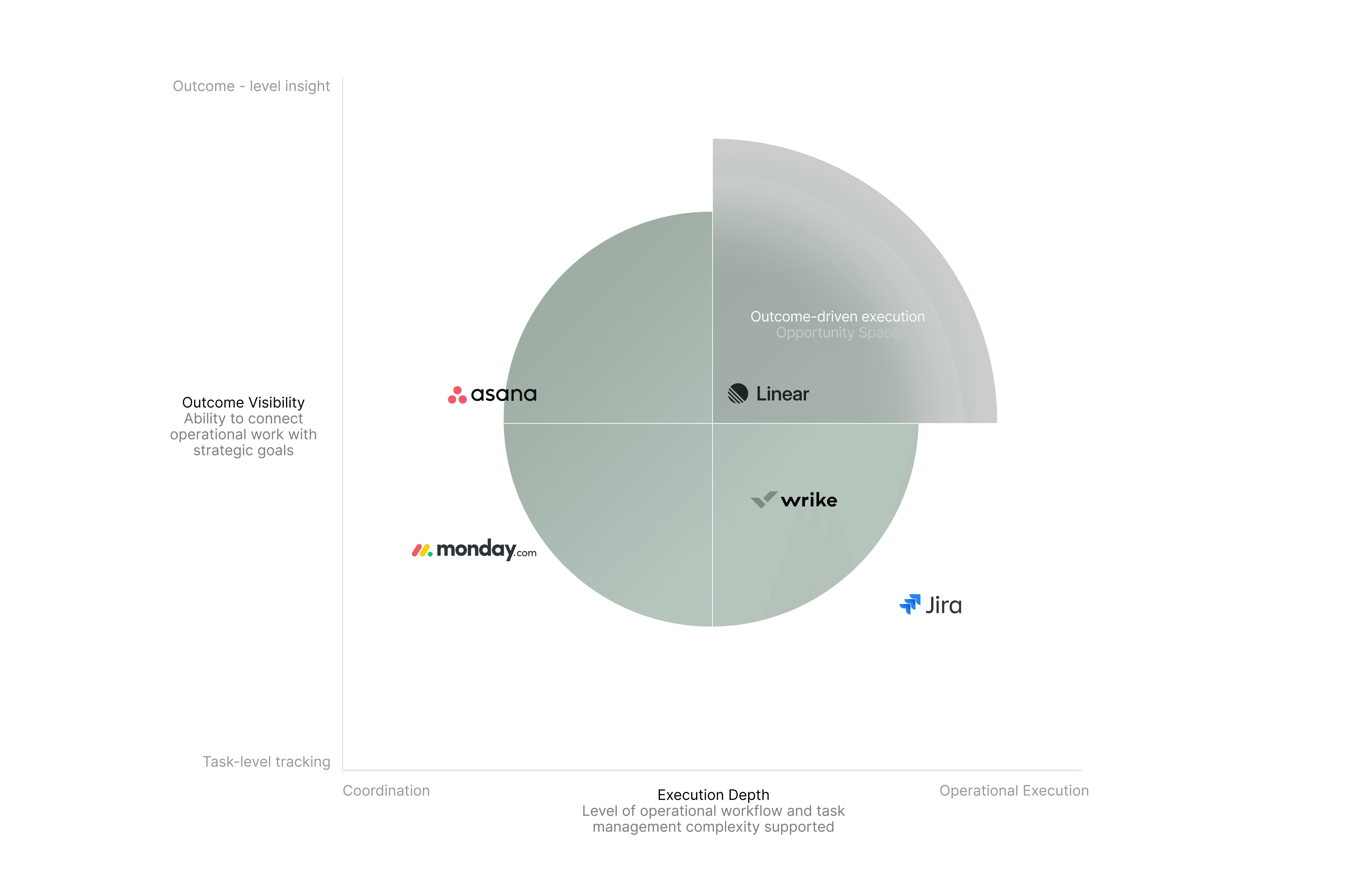
Landscape Scan of Project Management Tools
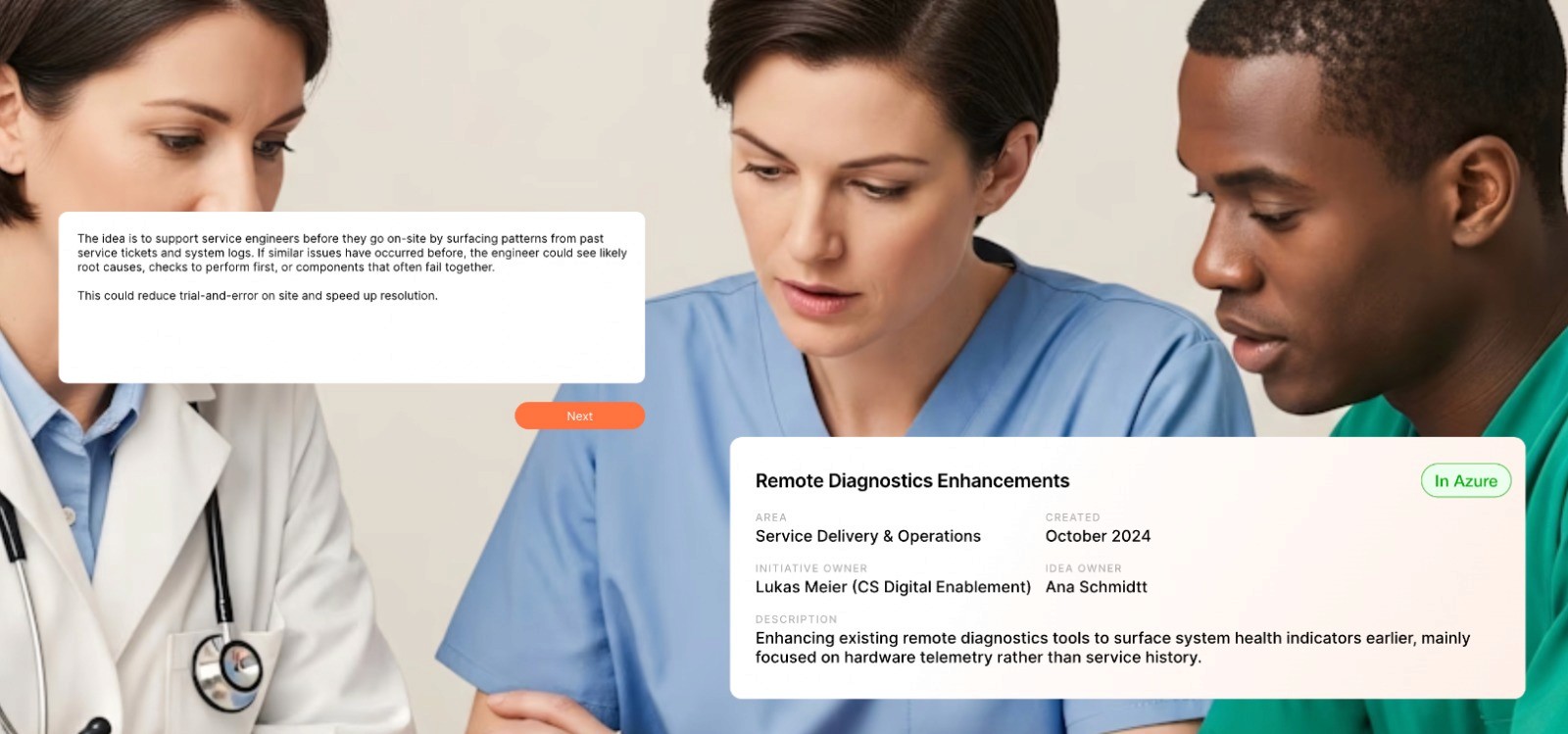
Mapping the current tool ecosystem to understand how teams manage execution and where opportunities for better outcome insight exist.

Most tools focus on tracking execution, but provide limited visibility into whether that work is driving meaningful outcomes.
social trends
To further explore what product leaders go through, I scanned LinkedIn and X, where they consistently called out tools for async work, context switching, people management, and were sharing endless project-management templates.


Reframed Problem Statement
How might we help modern teams reduce coordination debt + connect execution to org. goals, without adding more tools to their workflow?

Product vision
A platform that turns scattered execution across tools into clear, actionable insight, so teams can focus less on coordination and more on delivering meaningful outcomes.

NORTH STAR METRIC
Portfolio Alignment Pulse
a compact indicator showing what percentage of active projects are improving their execution to outcome alignment, compared to the previous tracking cycle (weekly or bi-weekly).
Each project generates an alignment score (0–100) derived from execution signals and goal linkage. The Portfolio Alignment Pulse tracks how many projects improve or decline across cycles.
Builds visibility into whether projects are strengthening or weakening outcome alignment
Provides portfolio-level progress, not just task progress
Supports a blend of an outcome and execution
driven management approach
Let’s say the PO manages 5 active projects under one portfolio:
Each project has its own alignment score (0–100), derived from its own execution mode
What we check: How many projects improved or remained stable?
look away for 20 seconds, 20 meters away, your eyes need rest
product capabilities and features
I distilled the research and opportunities into three core capabilities, project intelligence, AI assisted work assignment, and project metrics, that directly shape the features that were built.

Designs

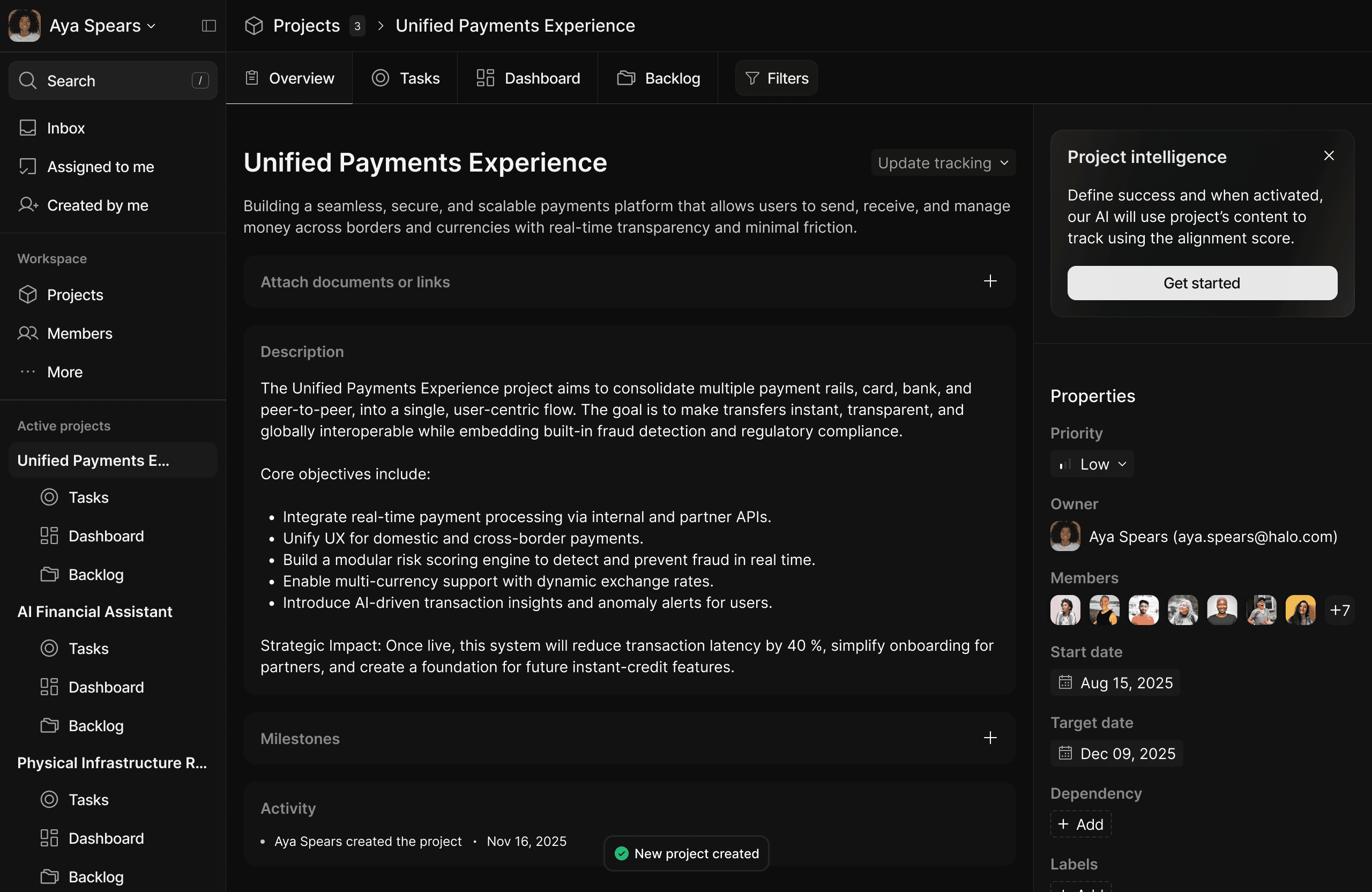
Creating and Managing Projects

Scannable list view of all projects with search. Aiming to cut through the usual noise, lowering cognitive load, support quick decisions, and make the whole portfolio feel manageable.
AI steps in here because writing from scratch is slow, and projects often start with the same boilerplate. It pulls together your choices, fills the empty page, and gets you moving without the usual friction.


The Project Intelligence feature lets you define what success looks like and connect the project to Org. goals or OKRs, allowing the AI to read project’s content and automatically track how well the work is aligning with the set goals. It’s needed because teams often lose sight of the original intent as projects evolve, and this keeps everyone aligned.

Viewing and updating tasks within a Project

Choosing the canvas task view was intentional, giving a flexible, zoomable space than fixed lists. Keeps the board spacious and clear even as the number of tasks grows.
AI steps in here to auto-assign who should own or contribute to a task, and picking the right people isn’t always straightforward. The model looks at the task’s details, skills needed, context, past work, and suggests the best fit automatically.
It allows for async work, saves time, and helps users avoid overloading someone who’s already stretched.

Dashboard view of project metrics and team performance statistics.

The KPIs show overall health, the status and type charts reveal where work is concentrated, and the trend graphs highlight how output and priorities are shifting over time. It’s a fast way to understand what’s happening and where attention is needed.
Shows team performance, how overloaded they are, and where work might be getting stuck. The top KPIs summarise team capacity and contribution trends, while the charts highlight overall patterns across sprints/cycles.
The Member capacity breakdown table was created to view each member’s critical data points at once. Visualising all of these as charts would have created noise, not clarity.

Key Takeaways
This project explored whether project tracking could move beyond execution metrics to reveal if work is actually driving outcomes. Designing the Portfolio Alignment Pulse required thinking through product logic, signal interpretation, and portfolio-level decision support. It also surfaced why this problem remains difficult to solve: outcomes are influenced by multiple teams, shifting priorities, and complex dependencies. Rather than perfect measurement, the concept relies on directional support that help teams detect alignment trends across projects.
Work
Play
ankulkarni98@gmail.com
Anuja Kulkarni
© 2026. All Rights Reserved.
Oh,